CEFR Levels Explained: A1 to C2 for German Learners
If you've spent any time researching German courses, you've run into the letters A1, B2, or C1 constantly, often without a clear explanation of what they actually mean or why they matter so much. These labels come from the CEFR framework, and understanding it properly is one of the most useful things you can do before starting your German learning journey, since it directly shapes your course choice, your timeline, and even which visa or career pathway you're actually eligible for. This guide breaks down every CEFR level from A1 to C2 in plain terms, what you can genuinely do at each stage, and how long it realistically takes to get there.
What Is the CEFR Framework?
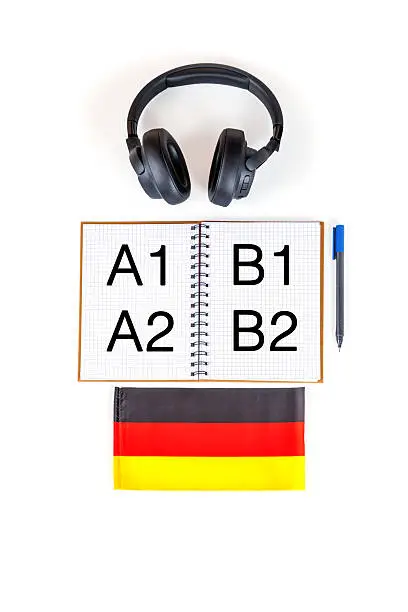
CEFR stands for the Common European Framework of Reference for Languages, an internationally recognized standard developed by the Council of Europe to describe language ability consistently across countries and languages. Rather than relying on vague labels like "beginner" or "advanced," which mean different things depending on who's using them, CEFR defines six clear levels, A1, A2, B1, B2, C1, and C2, each with specific, testable descriptions of what a learner can actually do. This is exactly why German certification bodies like Goethe-Institut and Telc structure their exams around these same six levels, giving employers, universities, and visa authorities a consistent, comparable benchmark regardless of where or how someone learned the language.
The Six CEFR Levels: A Quick Overview
| Level | Common Name | General Description |
|---|---|---|
| A1 | Beginner | Basic phrases and everyday expressions for immediate needs |
| A2 | Elementary | Simple, routine communication on familiar topics |
| B1 | Intermediate | Independent handling of everyday situations and familiar subjects |
| B2 | Upper Intermediate | Confident, detailed communication including work-related and abstract topics |
| C1 | Advanced | Fluent, spontaneous expression with strong command of complex language |
| C2 | Mastery |
This six-level structure is often grouped into three broader bands: A (Basic User), B (Independent User), and C (Proficient User). Most practical goals, work, study, visa applications, or nursing recognition, fall somewhere within the B band, which is why B1 and B2 come up so frequently across nearly every Germany-focused pathway.
A1: Beginner
At A1, you can understand and use basic, familiar everyday expressions and very simple phrases aimed at satisfying immediate needs. You can introduce yourself, ask and answer simple personal questions, like where you live or what you do, and interact in a basic way, provided the other person speaks slowly and is willing to help. This is the true starting point for anyone with no prior German exposure, and most learners with consistent study reach A1 within 6 to 8 weeks.
A2: Elementary
A2 builds on A1 with the ability to understand frequently used expressions related to areas of immediate relevance, such as shopping, local geography, employment, and personal information. You can communicate in simple, routine tasks requiring a direct exchange of information, and describe aspects of your background and immediate environment in basic terms. Reaching A2 from A1 typically takes another 6 to 8 weeks of structured study, putting most learners at A2 within roughly 3 to 4 months from the very beginning.
B1: Intermediate
B1 is often considered the first genuinely functional milestone, and it's frequently the minimum threshold for practical pathways like beginning an Ausbildung application or starting the nursing recognition process. At B1, you can understand the main points of clear, standard input on familiar matters encountered regularly at work, school, or leisure. You can deal with most situations likely to arise while travelling in a German-speaking area, produce simple connected text on familiar topics, and describe experiences, events, dreams, and ambitions, along with brief reasons for opinions and plans. Most learners reach B1 within 6 to 9 months of consistent, structured study from the beginning.
B2: Upper Intermediate
B2 represents a significant jump in capability, and it's the level most consistently required for independent professional practice, nursing recognition, healthcare-track Ausbildung, and many university admissions. At B2, you can understand the main ideas of complex text on both concrete and abstract topics, including technical discussions in your field. You can interact with a degree of fluency and spontaneity that makes regular interaction with native speakers possible without strain on either side, and produce clear, detailed text on a wide range of subjects while explaining a viewpoint with the advantages and disadvantages of various options. Building from B1 to B2 typically takes an additional 3 to 6 months, putting most learners at B2 within roughly 9 to 15 months from a complete beginner starting point, depending on study intensity.
C1: Advanced
C1 reflects genuine fluency and precision. At this level, you can understand a wide range of demanding, longer texts and recognize implicit meaning, express yourself fluently and spontaneously without obvious searching for expressions, and use language flexibly and effectively for social, academic, and professional purposes. C1 is typically pursued by candidates aiming for highly specialized professional roles, academic careers, or advanced university programs, rather than being a general requirement for most work or nursing pathways. Reaching C1 from B2 generally takes an additional 6 months or more, depending heavily on immersion and practice intensity.
C2: Mastery
C2 is the highest CEFR level, representing near-native mastery. At this stage, you can understand with ease virtually everything heard or read, summarize information from different spoken and written sources coherently, and express yourself spontaneously, very fluently, and precisely, differentiating finer shades of meaning even in complex situations. C2 is rarely a practical requirement for work, study, or visa purposes, it's typically pursued by those seeking careers in translation, academia, or highly specialized linguistic roles.
Realistic Timeline: How Long Each Level Actually Takes
| Level | Typical Additional Study Time | Cumulative Time from Zero |
|---|---|---|
| A1 | 6 to 8 weeks | 6 to 8 weeks |
| A2 | 6 to 8 weeks | 3 to 4 months |
| B1 | 2 to 3 months | 6 to 9 months |
| B2 | 3 to 6 months | 9 to 15 months |
| C1 | 6+ months | 15 to 21+ months |
| C2 | 6+ months | 21+ months |
These timelines assume consistent, structured study, generally a few hours of class time per week alongside regular practice, rather than casual or inconsistent self-study, which typically takes considerably longer to produce the same results.
Which CEFR Level Do You Actually Need?
This is ultimately the most important practical question, and the honest answer depends entirely on your specific goal, not a general sense of "how good" your German should be.
| Goal | Typical CEFR Requirement |
|---|---|
| EU Blue Card (highly skilled roles) | Often none required; A1-A2 helpful but not mandatory |
| General Skilled Worker Visa | B1 commonly accepted, varies by employer |
| Ausbildung (non-healthcare) | B1 typically sufficient |
| Ausbildung (healthcare tracks) | B2 mandatory |
| Nursing Recognition (Anerkennung) | B1 to begin, B2 for full licensure |
| University Admission (German-taught programs) | Typically B2 to C1, depending on the program |
| Family Reunification / Spousal Visa | A1 minimum, often higher recommended |
If you're unsure which category applies to you, it's worth reviewing your specific pathway in detail, since the required level meaningfully changes how you should plan your study timeline and course structure from the very beginning.
How CEFR Levels Map to Goethe and Telc Exams
Both major German certification bodies, Goethe-Institut and Telc, structure their exams directly around these same six CEFR levels, which is exactly why a B2 certificate from either body is treated as equivalent proof of the same underlying proficiency. This consistency is what allows employers, universities, and visa authorities to accept certificates from either exam body without needing to separately evaluate each one, since both are calibrated against the same internationally recognized CEFR descriptors.
Common Misconceptions About CEFR Levels
- "B2 means I'm basically fluent" — B2 is strong, functional proficiency, but C1 and C2 represent meaningfully higher levels of nuance and fluency
- "Higher is always better, so I should aim for C1 regardless of my goal" — unnecessary in most cases; the right level depends entirely on your specific pathway, and overshooting costs time you may not need to spend
- "Each level takes the same amount of time" — false; later levels generally take longer per level than earlier ones, since the skill gap being closed grows more complex
- "CEFR levels are the same as fluency milestones in every language" — CEFR is language-agnostic in structure, but the actual time and difficulty to reach each level varies depending on the specific language and your linguistic background
Choosing the Right Course for Your Target Level
Once you know which CEFR level your goal actually requires, the next step is choosing a course structured to get you there efficiently, rather than a generic program that treats every learner the same regardless of their end goal. This is where working with the best German language institute in Coimbatore genuinely matters, since a program that clearly maps its curriculum to CEFR benchmarks, level by level, gives you a much more reliable path to your target certificate than informal or loosely structured classes.
Sprachhaus Global Academy, a German language training institute based in Coimbatore, structures its courses directly around these CEFR benchmarks, from A1 through B2, with each level built to prepare candidates for the corresponding Goethe or Telc certification exam, rather than teaching general conversational German loosely aligned to a level in name only. For learners who already know their target CEFR level based on their specific goal, whether that's B1 for Ausbildung, B2 for nursing recognition, or B2 for a stronger university application, choosing the best German language institute in Coimbatore with this kind of clear, benchmark-driven structure makes a measurable difference in how efficiently you actually reach it.
Final Thoughts
The CEFR framework isn't just an abstract labeling system, it's the practical foundation that determines your course structure, your realistic timeline, and your eligibility for nearly every Germany-focused pathway, from work visas to nursing recognition to university admission. Understanding what each level from A1 to C2 genuinely represents, and knowing exactly which one your specific goal actually requires, saves you from both underpreparing and unnecessarily overshooting your target. Whether you're just starting out or already partway through your German learning journey, anchoring your plan to a clear CEFR target, and choosing a structured program built around those same benchmarks, is what turns a vague goal of "learning German" into a concrete, achievable milestone.
Ready to Take the Next Step?
Join our expert-led classes and start your journey towards a successful career in Germany today.